
Food is one of the quickest ways to understand Morocco. It tells you about season, hospitality, family, trade routes and the patience behind dishes cooked slowly and shared from the centre of the table.
It can also raise practical questions for a first-time visitor. What should you order first? What does a Moroccan breakfast include? Is street food safe? How do you avoid an upset stomach without becoming so cautious that you miss the pleasure of eating locally?
This guide answers those questions and explains the everyday dos and don’ts in Morocco that make travel feel easier and more respectful.
What is Morocco’s most popular food?
If one dish must represent Morocco, the answer is usually couscous or tagine. They are both central to Moroccan food, but they play different roles.
Couscous: the communal classic
Couscous comes from Amazigh culinary tradition and is one of Morocco’s defining dishes. Fine grains are steamed until light, then served with vegetables, broth and combinations of meat, chicken or, in some regions, fish. Sweet variations also exist.
It is traditionally associated with Friday and with sharing. A large dish arrives at the table and the meal becomes as much about gathering as eating. That social role is one reason couscous is often described as Morocco’s staple or emblematic dish.
Visitors sometimes expect couscous to be available everywhere, every day. Many tourist restaurants serve it throughout the week, but smaller traditional kitchens may prepare it mainly on Friday. Asking when it is cooked is often more useful than simply looking for it on a permanent menu.
Tagine: the dish with endless versions
A tagine is both the conical cooking vessel and the slow-cooked dish prepared inside it. Meat, fish or vegetables cook gently with spices and a small amount of liquid, allowing flavours to concentrate.
There is no single standard tagine. You may find chicken with preserved lemon and olives, beef or lamb with prunes, kefta with tomato and eggs, fish with chermoula, or a vegetable version built around what is in season.
Tagine may be the most widely encountered Moroccan main dish because every household, region and restaurant can make it differently. If couscous expresses gathering, tagine expresses variation.
Other Moroccan dishes worth knowing
Reducing Moroccan food to two dishes would miss much of its character. Look out for these favourites as well.
Tanjia
Tanjia is strongly associated with Marrakech. Meat is seasoned and cooked slowly in a terracotta jar, traditionally using the residual heat of a communal oven. The name sounds similar to tagine, but the vessel, method and resulting dish are different.
Harira
Harira is a nourishing soup commonly made with tomatoes, pulses, herbs and small pasta or flour for body. It is closely connected with Ramadan, when it is often eaten to break the fast, but it appears in restaurants at other times too.
Pastilla
Pastilla combines crisp pastry with a filling that may include poultry, seafood or almonds. Savoury and sweet elements often meet in the same dish, which can surprise visitors expecting a conventional pie.
Rfissa
Rfissa commonly brings chicken, lentils and a fragrant sauce together over shredded msemen or trid pastry. It is comforting, generous and particularly good for understanding how bread and sauce interact in Moroccan cooking.
Moroccan salads
The word salad may refer to a collection of cooked and raw vegetable dishes rather than one bowl of leaves. Zaâlouk uses aubergine and tomato; taktouka usually combines peppers and tomato. Carrots, courgettes, beetroot and lentils may each appear as separately seasoned plates.
Bread and mint tea
Bread accompanies many meals and is often used to gather food from a shared dish. Mint tea is more than a drink: it is part of welcome, conversation and hospitality. It may be sweeter than visitors expect, so ask politely if you prefer less sugar.
What is a typical Moroccan breakfast?
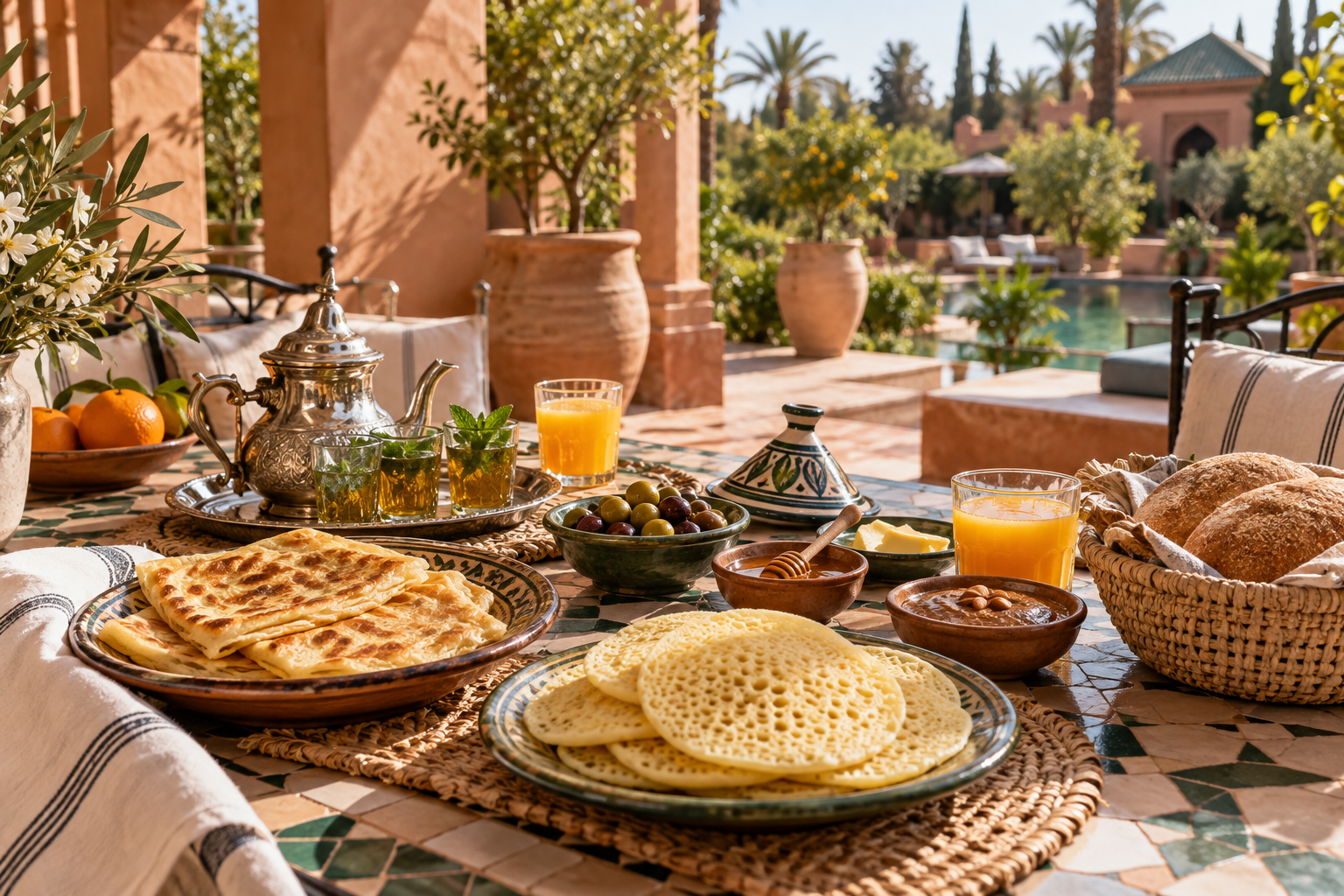
A typical Moroccan breakfast is usually a table of smaller items rather than one plated dish. What appears depends on the household, region and accommodation, but the pattern often includes bread, something warm from the griddle, spreads and tea or coffee.
You may find:
- Khobz: round Moroccan bread, served with olive oil, butter, cheese, honey or jam.
- Msemen: a layered, square flatbread with crisp edges and a soft centre.
- Baghrir: light, spongy pancakes marked by many small holes, often served with honey and butter.
- Harcha: a semolina flatbread with a slightly crumbly texture.
- Amlou: a rich spread traditionally made with almonds, argan oil and honey.
- Olives and olive oil: simple, savoury additions that make bread the centre of breakfast.
- Eggs: boiled, fried or cooked with tomato and spices, depending on the setting.
- Fresh fruit or yoghurt: common in hotels and more contemporary breakfasts.
- Mint tea, coffee or fresh juice: the usual drinks, with sweetness varying considerably.
Not every breakfast contains every item. A family kitchen, city café, riad and resort buffet will each interpret the meal differently.
The best approach is to try a little of several things. Warm msemen with honey tastes very different from bread dipped in olive oil, and the contrast between sweet and savoury is part of the experience.
At Life Resort, meals are designed to sit naturally around the rest of the day. A good breakfast should work whether you are heading into Marrakech, training, spending time by the pool or choosing a slower morning. You can explore the resort’s approach to fresh food on the restaurant page.
How to avoid getting sick in Morocco
Most travellers want practical advice, not alarm. Morocco welcomes millions of visitors, and a sensible approach to food and water reduces risk without requiring you to avoid local cuisine.
Official UK guidance advises travellers to follow good food and water hygiene to reduce the risk of stomach bugs. The CDC similarly notes that food and water standards vary and recommends safe choices while travelling. No checklist can remove every risk, but the following habits are useful.
Choose food that is freshly cooked and served hot
Heat is one of the clearest safety signals. A busy stall or restaurant where food is cooked in front of you and served immediately may be a better choice than food that has been sitting lukewarm for a long period.
This does not mean busy automatically equals safe, or quiet automatically equals unsafe. Look at turnover, cleanliness, refrigeration and how raw and cooked ingredients are handled.
Be thoughtful about water
Ask your accommodation for current local guidance on drinking water. When you are unsure, use sealed bottled water or properly treated water for drinking and brushing your teeth. Check that a bottle’s seal is intact.
Ice is only as safe as the water used to make it. Established hotels and restaurants commonly use treated water, but ask if you are uncertain.
Wash or sanitise your hands
Clean hands before eating, particularly when food is shared or eaten with bread. Carrying a small hand sanitiser is useful when soap and water are not immediately available.
Treat raw food with more caution
Raw salads, cut fruit and unpasteurised products require more trust in washing, refrigeration and preparation. Fruit you can peel yourself is a simple option when conditions are uncertain.
You do not need to reject every salad. Choose places with good hygiene and steady turnover, and be more cautious where food has been exposed to heat for a long time.
Check meat, eggs and seafood are properly cooked
Avoid meat, eggs or seafood that is undercooked or has been held at an unsafe temperature. Near the coast, freshness still matters; a sea view is not proof of safe storage.
Do not change everything on the first day
Travel, heat, dehydration, rich meals and more coffee than usual can upset digestion even without food poisoning. Eat at a comfortable pace, drink enough water and give your body time to adjust.
Take allergies seriously
The UK government notes that allergen information is not always consistently provided and cross-contamination risks may be higher than in the UK. Carry translated details of your allergy, make the risk clear and avoid dishes when the ingredients cannot be confirmed.
Nuts, sesame, wheat, eggs and dairy appear in many breads, pastries, sauces and desserts. Do not assume a dish is free from an ingredient because it is not visible.
Get appropriate health advice before travelling
Vaccination recommendations depend on your health, itinerary, length of stay and planned activities. Consult an appropriate travel-health professional in good time rather than relying on a blog for individual medical advice.
Know when to seek medical help
Rest and hydration may be enough for a mild, short-lived stomach upset, but persistent or severe symptoms need professional advice. Seek medical help urgently for signs such as blood in the stool, severe dehydration, intense pain, confusion, high fever or an inability to keep fluids down. Children, older travellers, pregnant people and those with underlying conditions may need help sooner.
Street food in Morocco: should you try it?
Street food can be part of a memorable Morocco trip. The useful choice is not “street food or no street food” but which vendor, which dish and what time.
Look for:
- Food cooked after you order it
- High customer turnover
- Separate handling of raw and cooked ingredients
- Clean utensils and surfaces
- Ingredients protected from dust, insects and prolonged sun
- A vendor who can explain what the dish contains
If your stomach is sensitive, begin with cooked breads, soups or grilled foods rather than a large selection of unfamiliar raw dishes. You can become more adventurous once you understand how your body is responding to the change in routine.
Dos and don’ts in Morocco
Morocco is diverse and accustomed to international visitors. Etiquette changes between a family home, a resort, a mosque area, a city café and a rural village. Thoughtfulness matters more than memorising a rigid list.
Do greet people
A simple greeting changes the tone of an interaction. “Salam alaykum” is widely understood, while French is also commonly used in tourism and business. Beginning with hello before asking a question is courteous.
Do dress with context in mind
Tourist areas are varied, but modest clothing is a respectful default, particularly in rural communities and around religious sites. Covering shoulders and knees is a useful guide when you are unsure.
This is not about treating every location as identical. A pool, restaurant, medina and mosque entrance each have different expectations. Carrying a light layer makes adjustment easy.
Do ask before photographing people
A market scene may be visually irresistible, but the people within it are not simply part of the scenery. Ask before taking a close photograph, especially of workers, performers, children or anyone in a private moment.
Some performers expect payment for photographs. Agree clearly before taking the picture rather than arguing afterward.
Do bargain politely where bargaining is normal
Negotiation is common in souks, but it should remain friendly. Ask the price, make a reasonable counteroffer and be prepared to walk away without hostility. Once both sides clearly agree, completing the purchase is good manners.
Fixed-price shops, restaurants and modern retail spaces are different. Do not bargain simply because you are in Morocco.
Do respect Ramadan
Ramadan dates move each year. During the fasting month, many people do not eat or drink between dawn and sunset. Opening hours and the pace of the day may change.
UK travel guidance advises visitors to respect local customs and notes that eating, drinking, smoking or chewing gum publicly during daylight may cause offence. Tourist hotels and restaurants may continue serving guests, sometimes in screened areas. Follow local advice and be patient, especially late in the afternoon when people may be tired.
Do use your right hand when sharing food
When eating from a shared dish by hand, the right hand is traditionally used. Take food from the section nearest you rather than reaching across the dish.
If cutlery is provided, using it is completely normal. Watch your host or ask if you are uncertain.
Don’t assume every mosque is open to non-Muslims
Access rules vary. Some religious sites may be viewed only from outside by non-Muslim visitors. Follow signs and local instructions, dress respectfully and never push past a boundary for a photograph.
Don’t display anger during ordinary negotiation
Traffic, directions and market discussions can feel intense. Raising your voice rarely improves the situation. Stay calm, confirm prices in advance and ask your hotel or host for help when something is unclear.
Don’t accept unofficial help without clarifying the arrangement
An offer to guide you through the medina or show you a shop may involve a fee or commission. That does not make every offer dishonest, but it is better to ask clearly whether there is a charge before following someone.
Don’t forget that alcohol is context-dependent
Alcohol is available in many licensed hotels, restaurants and shops, but it is not appropriate everywhere. Drink discreetly, never behave aggressively and do not carry an open drink through public areas where it may cause offence.
Don’t treat animals as photo props
Avoid touching or feeding unfamiliar animals. Beyond welfare concerns, bites and scratches can carry serious health risks, including rabies. If you are bitten or scratched, wash the wound thoroughly and seek urgent medical advice.
How to enjoy Moroccan food without rushing it
The best meals are not necessarily the ones with the longest list of famous dishes. One well-made tagine, a few vegetable salads, bread and tea can tell you more than a hurried tasting menu.
Try to leave time for:
- A traditional breakfast with msemen or baghrir
- Couscous on a Friday if it fits your itinerary
- A Marrakech tanjia
- Several cooked Moroccan salads
- Seasonal fruit
- Mint tea served as hospitality, not only refreshment
- A meal outside the busiest tourist streets
If you are staying for several days, alternate richer dishes with simpler meals. Fresh vegetables, grilled food, soup and fruit make it easier to keep enjoying Moroccan cooking rather than reaching the point where every meal feels like an event.
Guests at Life Resort can combine meals with private accommodation, time in the spa and a choice of Marrakech experiences. That makes it easier to enjoy food as part of the day’s rhythm rather than fitting it between constant transfers.
Frequently asked questions
Is couscous or tagine more popular in Morocco?
Both are fundamental. Couscous has a particularly strong communal and Friday tradition, while tagine appears in a wider variety of everyday forms. A visitor should try both rather than choosing one as the definitive dish.
What do Moroccans drink at breakfast?
Mint tea and coffee are common. Fresh orange juice is also widely available, particularly in hotels and cafés. Breakfast habits vary by household and region.
Can vegetarians eat well in Morocco?
Yes, but confirm whether a vegetable dish uses meat stock. Vegetable tagines, salads, lentils, beans, breads and couscous can provide good options when preparation is clear.
Is Moroccan food very spicy?
Moroccan cooking is highly seasoned but not always hot with chilli. Cumin, ginger, cinnamon, turmeric, coriander, saffron and spice blends create fragrance and depth. Harissa or chilli may be served separately.
Can I drink tap water in Marrakech?
Local conditions and individual tolerance vary. Ask your accommodation for current advice. If you are unsure, drink sealed bottled water or appropriately treated water and use the same approach for brushing your teeth.
Should I avoid all street food?
No. Choose vendors carefully, favour freshly cooked food served hot and pay attention to turnover and hygiene. Travellers with particular health needs should seek individual medical guidance before the trip.
Come curious, eat thoughtfully
Moroccan food is not a checklist to complete. It is an invitation to slow down, share and notice how much care can sit inside a piece of bread, a glass of tea or a dish that has cooked for hours.
Try the famous plates, but also pay attention to breakfast, vegetables, bread and the small acts of hospitality around them. Follow sensible food hygiene, respect the context you are in and ask when you do not know.
That combination — curiosity without carelessness — is the best way to eat well in Morocco and return home remembering the pleasure rather than the precautions.